
Electric Actuators Replacing Hydraulic Cylinders: A Practical Decision Guide
You manage a production line, maintain industrial equipment, or design machinery. At some point, the question comes up: can I swap these hydraulic cylinders for electric actuators — and should I?
The short answer: electric actuators now handle forces once reserved for hydraulics, with better efficiency and far less maintenance. But the real answer depends on your application, your operating conditions, and how you size the replacement.
This guide walks through the comparison, the numbers, and a practical framework for deciding whether the switch makes sense for your setup.
Electric vs. Hydraulic Actuators — How the Technologies Stack Up
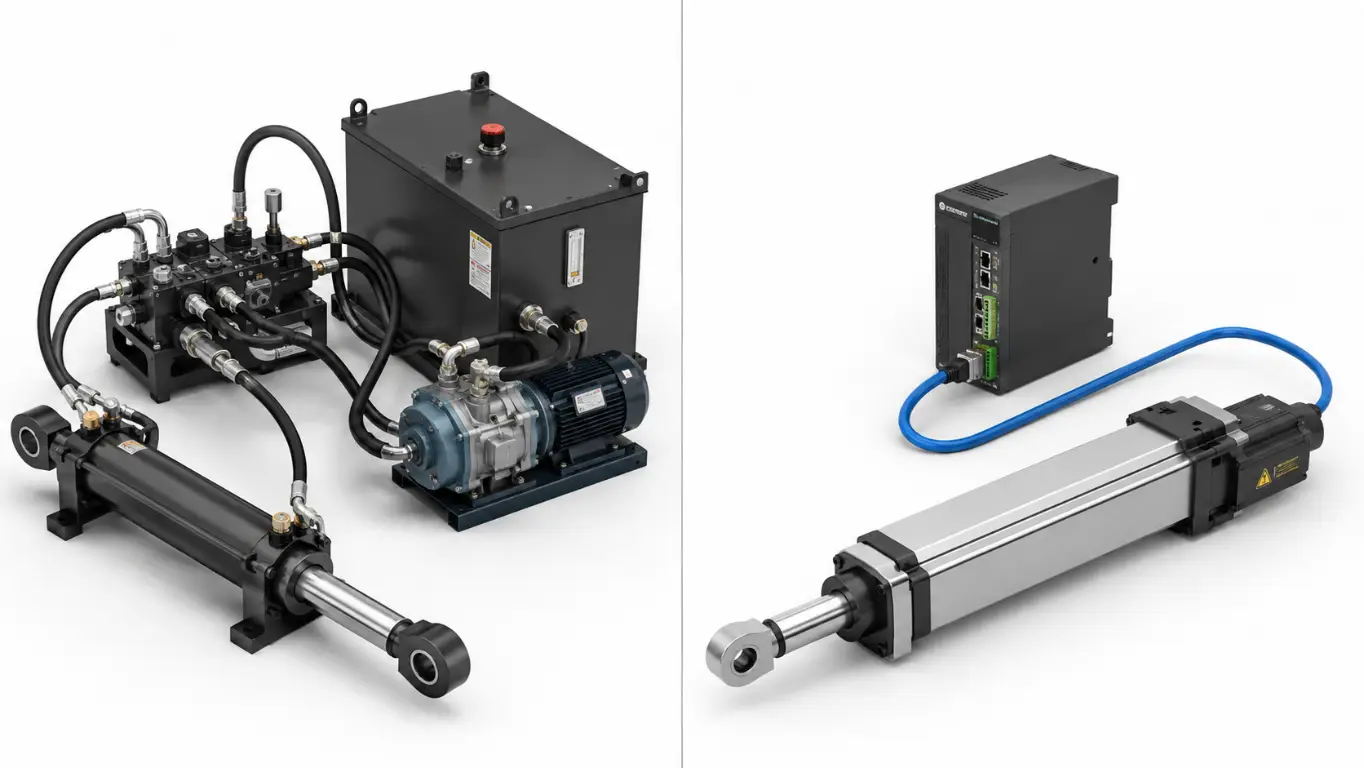
Before diving into costs and applications, understand what each technology does well and where it falls short. The goal is not to declare a winner — the two serve different purposes — but to give you a clear picture of where electric actuators genuinely outperform hydraulics and where hydraulics still hold an edge.
Where Electric Actuators Outperform Hydraulic Cylinders
Three dimensions tell the story: precision, efficiency, and operating environment.
On precision, the difference is architectural. Electric actuators use closed-loop servo control with encoder feedback. They hold position at any point along the stroke with repeatability down to ±0.01 mm. A standard hydraulic cylinder, by contrast, operates open-loop — mid-stroke positioning requires an operator to feather a valve by feel. If your application needs multiple programmable positions or variable speed profiles, electric is the only practical choice.
On efficiency, the numbers are striking. Electric actuator systems operate at 75–80% total system efficiency, while hydraulic systems typically run at 40–55% (Tolomatic, 2025). The reason is fundamental: an electric motor draws current only when it moves the load. A hydraulic power unit runs continuously, consuming 30–40% of full-load power even when the cylinder sits idle. Over a year of operation, that idle consumption adds a significant line item to the electricity bill.
On the operating environment, electric eliminates the single biggest practical headache of hydraulics: oil. No leaks on the factory floor. No disposal of used hydraulic fluid. No contamination risk in clean-room, food-processing, or medical-device manufacturing. Modern electric actuators with IP65 or better sealing operate reliably in dusty, wet, or washdown conditions without the environmental baggage of a hydraulic system.
The Real Limitations of Electric Actuators Today
Candor matters here. Electric actuators have real boundaries, and pretending otherwise sets up a failed project.
The first limitation is sheer force. While roller-screw electric actuators now deliver up to 225 kN (roughly 50,000 lbf), large hydraulic cylinders easily exceed this. A 127 mm (5-inch) bore cylinder at 2,200 psi generates over 190 kN of force — and hydraulic pressures can go much higher. For large forging presses or heavy stamping, hydraulics remain the only practical option at the extreme end of the force spectrum.
The second is shock loading. Hydraulic fluid is naturally compressible and absorbs impact energy — a cylinder hitting a hard stop transfers some of that force into the fluid rather than the mechanical structure. An electric actuator with a rigid screw drive transmits impact forces almost directly into the screw and bearings. In applications with frequent hard stops, sudden load spikes, or unpredictable impact, the electric actuator needs careful oversizing, external dampening, or may simply not be the right choice.
The third is continuous heavy-duty operation. Electric actuators have a rated duty cycle — typically 25–50% depending on the model. Running beyond that generates heat that degrades motor insulation and lubricant. Hydraulic systems, with their large oil reservoirs acting as heat sinks, handle continuous high-force operation without the same thermal constraints.
The takeaway: electric is the stronger choice for precision, cleanliness, and total efficiency. Hydraulic remains essential where extreme forces, shock tolerance, or uninterrupted heavy cycling dominate the requirements.
The Numbers That Matter — Cost, Efficiency, and Total Ownership
When an engineer proposes switching from hydraulic to electric, the first question from management is almost always about cost. Most comparisons make the mistake of looking only at the purchase price of the actuator versus the cylinder. That is like comparing the price of an engine to the price of a car — it misses the system around it.
The real cost story has three chapters: energy, maintenance, and the five-year total.
Energy Consumption — The Hidden Cost Driver
A hydraulic system is inherently inefficient. The power flows through an electric motor (losing ~10%), into a pump (losing another ~15%), through valves and plumbing (losing ~30% to pressure drops and flow restrictions), and finally reaches the cylinder. Total system efficiency lands around 40–55% in well-maintained installations.
An electric actuator system takes a much shorter path: servo drive (95%+ efficient) → motor (90%) → screw (90%). The result is 75–80% total efficiency — roughly double what hydraulics achieve (Tolomatic, 2025).
What does this mean in real money? Consider a system with eight axes, each operating 16 hours a day, 250 days a year. A hydraulic setup might consume $8,000–$12,000 in electricity annually just to keep the pump running and overcome system losses. An equivalent electric system would draw $2,500–$4,000 — a difference that can pay back the higher initial hardware cost within two to three years on energy savings alone.
Maintenance — The Iceberg Beneath the Surface
If energy is the visible cost, maintenance is the submerged part of the iceberg.
A hydraulic system demands ongoing attention: oil changes every 2,000–4,000 operating hours, filter replacements on the same schedule, seal replacements every one to three years, and — almost inevitably — leak repairs. Each of these events means downtime. A single hydraulic leak can cost anywhere from a few hundred dollars for a simple seal replacement to several thousand when you factor in lost production, cleanup, and environmental compliance paperwork.
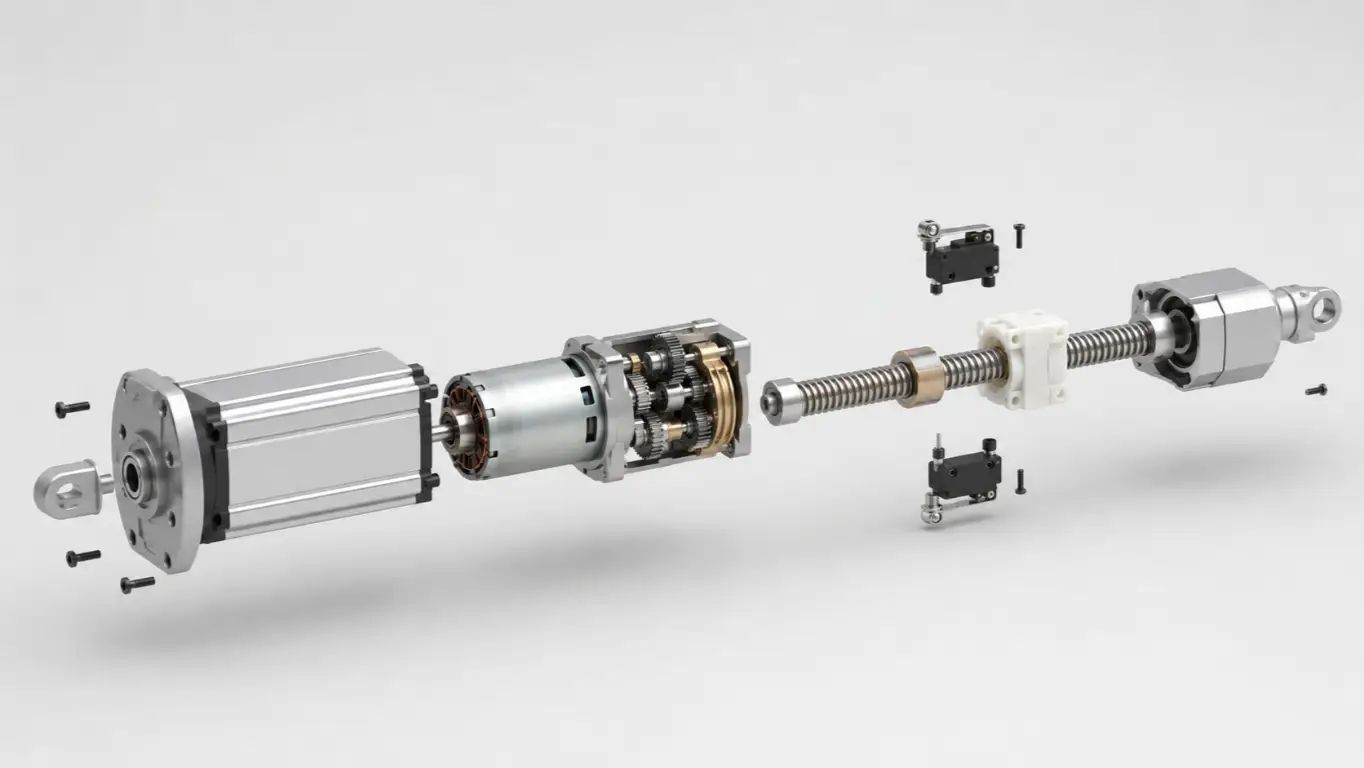
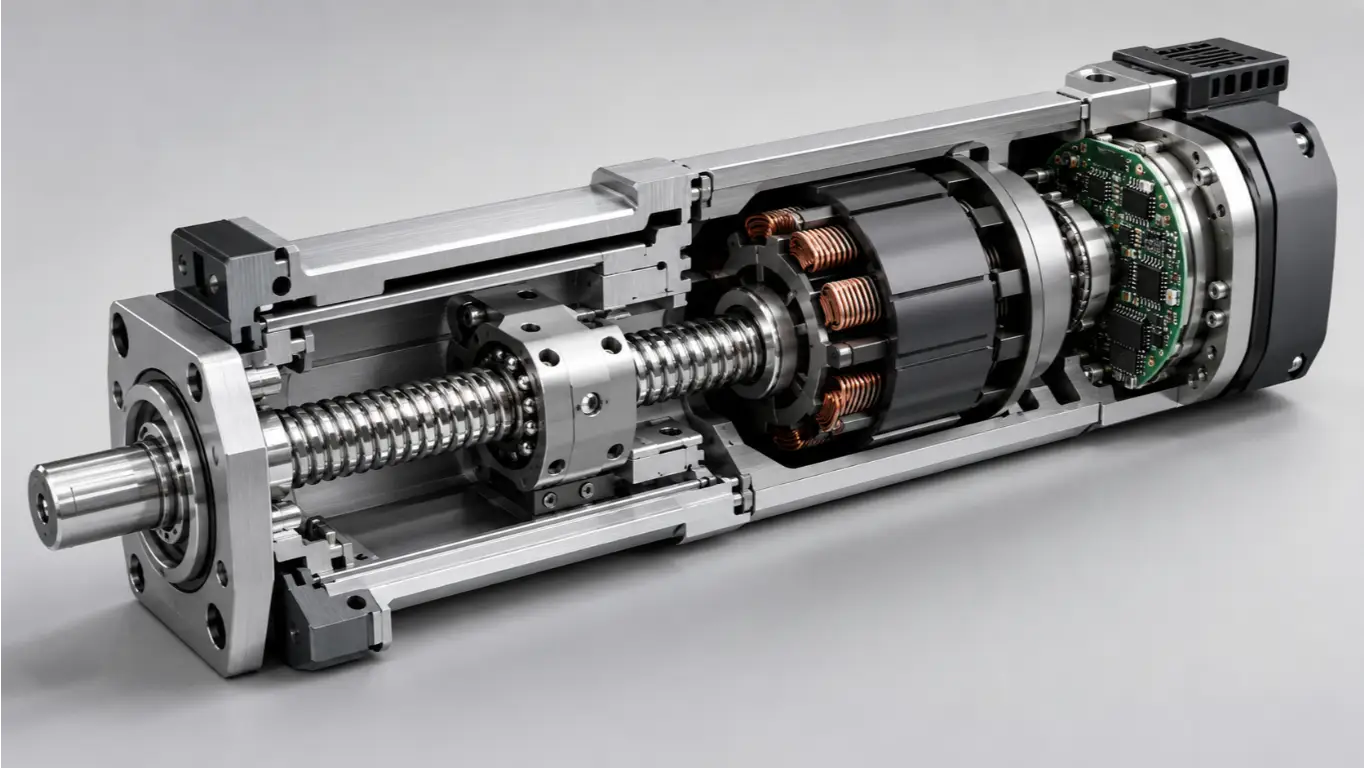
An electric actuator, sized correctly for the application, can run its entire service life with nothing more than occasional re-lubrication. The screw and bearing assembly is sealed inside the actuator body. There are no filters to change, no oil to sample and replace, and no seals exposed to high-pressure fluid that will eventually fail.
For a production manager tracking OEE (Overall Equipment Effectiveness), this difference shows up not just on the maintenance budget line but in the uptime percentage — and that is usually where the biggest financial impact lives.
Total Cost of Ownership — A 5-Year View
Bringing the pieces together, here is a simplified five-year comparison for a small production line with four axes:
| Cost Category | Hydraulic System (4 axes) | Electric System (4 axes) |
|---|---|---|
| Initial hardware (actuators + power unit + plumbing/cables) | $18,000–$30,000 | $12,000–$22,000 |
| Installation & commissioning | $3,000–$6,000 | $1,500–$3,000 |
| Annual energy cost | $4,000–$6,000 | $1,200–$2,000 |
| Annual maintenance (parts + labor) | $2,500–$5,000 | $200–$500 |
| 5-year total | $50,500–$86,000 | $19,200–$34,500 |
The hydraulic system looks cheaper on the initial hardware line because the cylinders themselves are inexpensive — but the pump, reservoir, valves, hoses, and filtration add up quickly. The electric system has a higher per-actuator cost but eliminates the entire hydraulic infrastructure. Over five years, the total cost of ownership gap is typically two to three times in favor of electric, driven primarily by energy and maintenance savings.
The caveat: these numbers assume you are building a new system or doing a complete retrofit. If you already have a functioning hydraulic power unit serving ten other axes and you are only replacing one, the payback math changes — the pump still runs for everything else, so your energy savings are limited to that single axis. In that scenario, go electric for the axes that need precision or cleanliness, and keep the hydraulic infrastructure for the rest.
Is Your Application Ready for the Switch?
This is the question that most white papers and manufacturer guides skip over — and it is the one that matters most to you. The answer is not a simple yes or no. It depends on what you need your actuator to do, where it operates, and what kind of production environment surrounds it.
Applications Where Electric Already Wins
Here are four real-world scenarios where electric actuators have proven themselves as direct hydraulic replacements:
Automotive assembly and press-fit operations. In electric vehicle battery manufacturing, servo electric actuators handle cell stacking and module compression with force control accuracy of ±0.5% of full scale — something a hydraulic system cannot deliver without expensive servo-hydraulic upgrades. The same applies to bearing press-fitting, where precise force-distance profiles prevent damage to sensitive components.
Medical device and laboratory equipment. MRI-compatible patient positioning tables, surgical robot arms, and diagnostic imaging equipment all share three requirements: precise positioning, silent operation (under 50 dB), and zero risk of fluid contamination. Electric actuators satisfy all three simultaneously.
Food, beverage, and pharmaceutical packaging. These environments demand washdown capability and absolute freedom from lubricant contamination. An electric actuator with IP65 or IP69K sealing meets these requirements natively. A hydraulic cylinder requires extensive guarding, drip trays, and a constant vigilance that most plants would rather eliminate from their process.
Clean energy and energy storage systems. Solar tracking systems, battery swap stations for electric vehicles, and automated energy storage container handling all use electric linear actuators. In these applications, the actuators often need to hold position without power for extended periods — something a self-locking screw mechanism does inherently, while a hydraulic system would need continuous pump pressure or an external locking device.
When Hydraulic Cylinders Still Make More Sense
Honesty about limits makes the rest of this guide credible. Here are the scenarios where hydraulics remain the right answer:
Extreme force applications. If you operate a 500-ton forging press or a heavy stamping line, the force requirement alone makes electric impractical. At this scale, a single hydraulic cylinder delivers what would require multiple synchronized electric actuators — and the cost and complexity of multi-axis electric synchronization quickly exceed the hydraulic alternative.
Mobile equipment in harsh environments. Construction machinery, mining equipment, and agricultural implements operate in mud, dust, extreme temperatures, and under constant vibration and shock. Hydraulic systems have decades of proven reliability in these conditions. Electric actuators can work here, but they need substantial protection, heating elements for cold starts, and careful shock management — adding cost and complexity.
Facilities with existing hydraulic infrastructure. If your plant already has a well-maintained hydraulic power unit serving 15 axes, replacing one axis with electric while keeping the pump running for the other 14 saves almost no energy. The smarter strategy: either convert the full system or selectively electrify only the axes where precision, cleanliness, or positioning flexibility justifies the investment independently of energy savings.
The Self-Assessment Checklist
Most applications that score 5+ on the checklist are ready for electric. If yours is one of them, the next step is getting a properly sized recommendation.
Get a Sizing RecommendationHow to Size an Electric Actuator to Replace a Hydraulic Cylinder
Here is the single most common mistake in hydraulic-to-electric conversions: taking the hydraulic cylinder’s rated force and using it to size the electric replacement.
Most hydraulic cylinders in industrial service are oversized by a factor of two or three. Why? Because cylinders themselves are inexpensive, and a larger cylinder provides “insurance” against unexpected loads without adding much to the system cost. Apply this inflated force number to size an electric actuator, and you end up specifying a unit two to three times larger and more expensive than what the application actually needs — and you may conclude, incorrectly, that electric “costs too much.”
The correct approach has four steps:
Step 1: Measure the actual force. The gold standard: install a load cell on the cylinder rod and record force through a full operating cycle. If that is not practical, measure pressure at both cylinder ports during operation and calculate force as (P₁ × A₁) − (P₂ × A₂). Or, gradually reduce system pressure until the cylinder barely performs the work and back-calculate the required force.
Step 2: Determine the actual speed profile. Do not use the pump’s rated flow divided by cylinder area — that gives you the maximum possible speed, not the speed the application needs. Record the cylinder in operation on video and use timestamps with known stroke length to calculate the real travel speed. Most applications run well below the hydraulic system’s maximum capacity.
Step 3: Define the duty cycle. How many cycles per day? What is the stroke length per cycle? How much dwell time between cycles? These numbers determine whether the electric actuator needs forced cooling, a larger frame size for heat dissipation, or can operate comfortably within its standard rating.
Step 4: Plug the real numbers into a manufacturer’s sizing tool. Tolomatic, Parker, SKF, and Thomson all provide online sizing software. Input the actual force, speed, stroke, and cycle count — not the hydraulic system’s nameplate numbers — and the tool will recommend a properly sized actuator with a calculated service life.
| Sizing Method | Accuracy | Equipment Needed | Best For |
|---|---|---|---|
| Load cell measurement | ±2% | Load cell + data logger | New builds, critical applications |
| Dual-port pressure measurement | ±10–15% | Pressure gauges + test ports | Existing systems with accessible ports |
| Pressure reduction method | ±15–20% | Adjustable pressure relief valve | Quick feasibility checks |
| Prototype current back-calculation | ±5–10% | Servo drive with current monitoring | When prototype electric hardware is available |
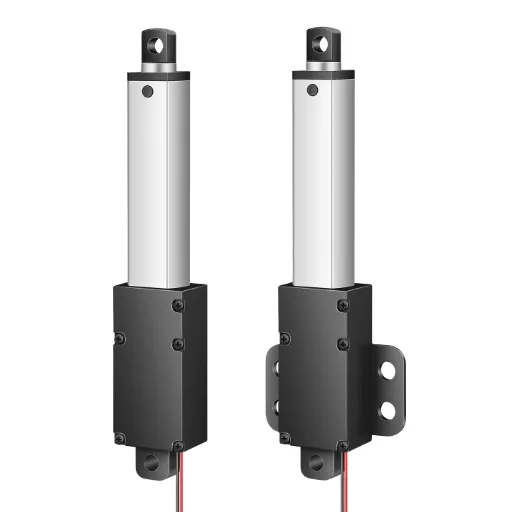
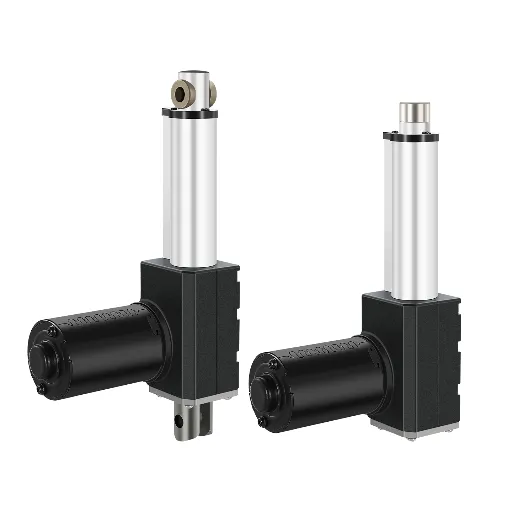
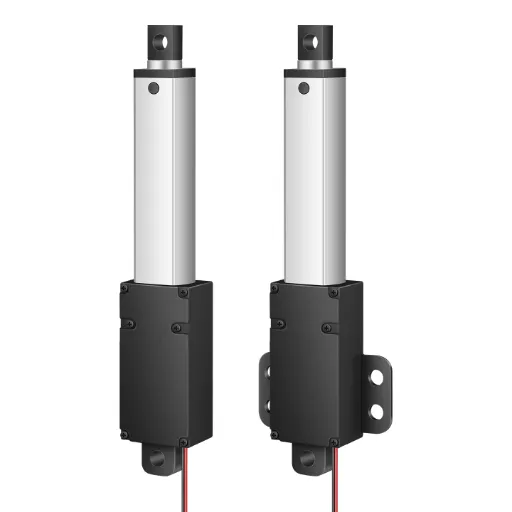
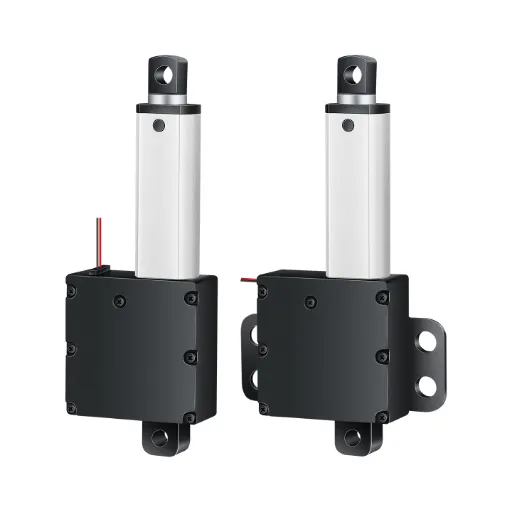
One final point: a correctly sized electric actuator, matched to actual application loads, will deliver its full rated service life — typically 10,000 hours or more on the screw assembly. Over-sizing wastes budget without adding meaningful life. Under-sizing — or, more commonly, failing to account for shock loads and duty cycle — leads to premature failure. This is where working with a manufacturer that offers application engineering support makes a tangible difference. Hoodland, for example, provides custom linear actuator solutions with parameter-level configurability — force, speed, stroke, mounting, IP rating, sensors, and communication interfaces can all be specified to match the application, and their engineering team can assist with sizing calculations based on your actual operating conditions. More broadly, when evaluating suppliers, prioritize those who ask about your load cycle and operating environment before quoting a price — it is the single best indicator of whether the actuator you get will be the actuator you need.
Finding a Reliable Electric Actuator Manufacturer
The electric actuator market has a visible top layer and a much larger subsurface. The top search results for “electric linear actuator” are dominated by familiar Western brands: Tolomatic, Parker Hannifin, SKF, Thomson Linear, and Curtiss-Wright (Exlar). These companies produce excellent products with strong application engineering support and extensive documentation. They are also priced accordingly.
Beneath this visible layer is a global supply base that includes established Chinese manufacturers — companies that have spent decades building precision motion components, hold international certifications, and serve export markets in 50-plus countries. These manufacturers often offer advantages in three areas that matter to cost-conscious engineering teams: customization flexibility (custom force, speed, stroke, mounting, and control parameters without minimum order quantity constraints), lead time responsiveness, and competitive pricing for equivalent specifications.
When evaluating any manufacturer — regardless of geography — focus on five criteria:
- Customization depth. Can they modify force, speed, stroke, mounting brackets, cable length, connectors, sensors, and IP rating to match your requirements — or are you limited to a catalog of fixed configurations? If your application has any deviation from standard, the answer to this question determines whether the project moves forward or stalls.
- Quality assurance protocol. Ask whether every unit undergoes a full-parameter final inspection or whether they use statistical sampling. Ask about aging tests — do they run every actuator through a burn-in period before shipping? These practices directly affect field reliability and your warranty return rate.
- Certification coverage. For export markets, CE and RoHS are table stakes. ISO 9001 signals process maturity. Industry-specific certifications — such as explosion-proof ratings for energy storage applications or medical-device compliance for healthcare equipment — indicate technical depth beyond basic manufacturing.
- Technical communication. The quality of the pre-sales conversation is the strongest predictor of the post-sales experience. Does the sales contact ask about your load cycle, duty cycle, operating environment, and mounting constraints — or do they jump straight to price? A supplier with application engineering capability will save you from sizing errors that only surface months into production.
- Delivery reliability. Ask for a lead time commitment in writing. Ask about their raw material inventory strategy — suppliers with stable, long-term relationships with raw material vendors are far less likely to hit delivery delays when demand spikes.
The right manufacturer fits your specific balance of technical requirements, volume expectations, and budget constraints — not necessarily the one with the largest advertising presence in search results.
If you are evaluating suppliers, factor lead time commitments and minimum order policies into your comparison. Hoodland, for instance, ships standard custom configurations in three to seven days with no minimum quantity requirement.
Share your requirements — our application engineers typically respond within 12 hours.
Discuss Your Application Typical response within 12 hours · No minimum order quantityReferences
- Tolomatic. “How to Convert Hydraulic Actuators to Electric.” 2025. tolomatic.com
- Tolomatic. “High-Force Linear Motion.” 2025. tolomatic.com
- Tolomatic. “Making the Jump to Electric” (Ryan Klemetson). 2025. tolomatic.com
- Motion Control Tips. “Electric Actuators as an Alternative to Hydraulic Cylinders.” motioncontroltips.com
- Industrial Technology / INMOCO. “Hydraulic Actuator Replacement: Accurately Sizing an Electric Upgrade.” industrialtechnology.co.uk
- SKF. “High Performance Electromechanical Actuator Range.” skf.com
- Automation World. “Preference for Electromechanical Actuators on the Rise.” 2025. automationworld.com
- CMCO / Duff-Norton. “Hydraulic vs. Electric Linear Actuator: Which is Best?” cmco.com
- Hoodland. “Custom Linear Actuator Solutions.” thehoodland.com
- Hoodland. “Contact Us.” thehoodland.com
- Hoodland. Homepage. thehoodland.com

 English
  Chinese